

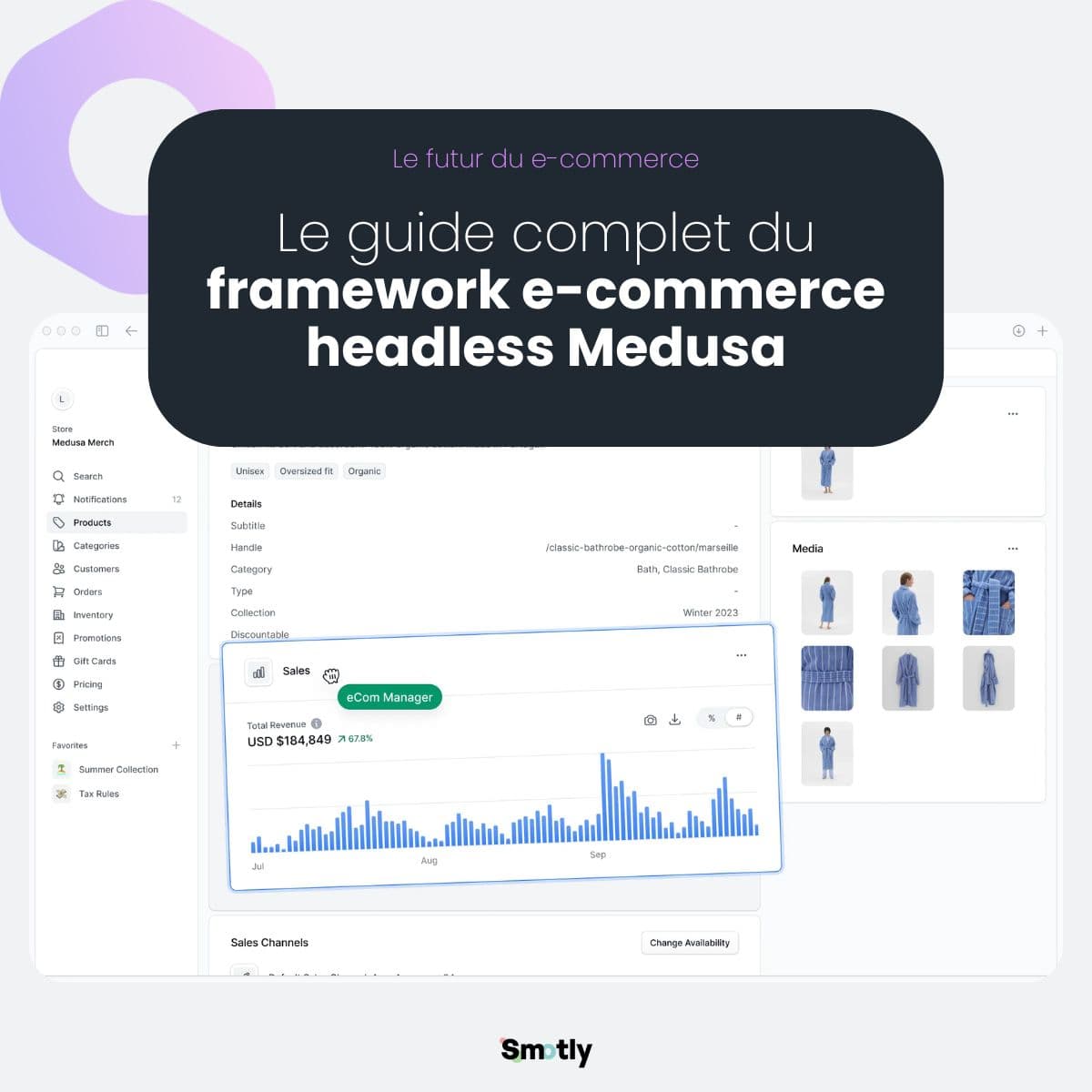
Online commerce is evolving rapidly. Traditional e-commerce platforms are today showing their limits in the face of businesses' growing needs for customization, performance and flexibility.**
Developers often find themselves stuck between turnkey solutions that are too rigid and development from scratch that is too costly. It is in this context that Medusa.js is gradually establishing itself as a serious alternative. This open source headless e-commerce platform offers a different approach: it combines the power of a modern framework with the total flexibility that developers need to create truly tailor-made shopping experiences.
With more than 32,000 stars on GitHub and a community of more than 14,000 developers, Medusa is attracting the attention of startups and even large companies like Heineken or Mitsubishi.
In this comprehensive guide, we'll take a look at what Medusa.js is, how it works, its main features, and most importantly, why this framework could become your next choice for developing powerful and scalable online stores.
1. Medusa.js: what is it and how does it work?
1.1 Definition of the Medusa.js framework
Before diving into Medusa, let's clarify an essential term: what is a framework?
A framework (or “working framework” in French) is a software structure that provides a base and ready-to-use tools for developing applications. Rather than starting from scratch, developers use a framework that already contains basic functionality, code organization rules, and reusable components. It’s a bit like having a house with the foundations, walls and plumbing already in place: all that remains is to arrange and customize according to your needs.
In the e-commerce context, a framework provides the essential building blocks (product management, shopping cart, payment, etc.) so that you do not have to recode everything manually.
Medusa.js is an open source headless e-commerce framework based on Node.js and TypeScript that allows you to create fully customizable e-commerce platforms. Unlike traditional e-commerce solutions like Shopify, Prestashop, Sylius or even WooCommerce, Medusa does not impose a rigid structure. Developers can modify, extend or replace the different components of the platform in order to meet the specific needs of their project.
Medusa's goal is simple: to provide all the fundamentals of an e-commerce platform while giving developers the freedom to build a completely tailor-made user experience.
Technically, Medusa.js is:
- a headless e-commerce framework built on Node.js and TypeScript
- an open source platform distributed under the MIT license (therefore freely modifiable)
- a modular architecture based on reusable commerce modules
- an API-first platform that exposes all of its functionalities via REST APIs
Medusa's DNA is based on a simple but powerful philosophy: providing the essential blocks of commerce (products, orders, payments, customers, promotions, etc.) while giving developers total freedom to customize how the platform works.
It should be noted that the technical stack on which Medusa Node.js, Next.js, React is based is the most used by developers around the world. Another essential point is the native integration of AI in this environment.
This hyper-modern approach differs greatly from other platforms on the market that appear almost outdated. More cumbersome to maintain, to evolve, to personalize, these established platforms are already much less attractive in comparison.
1.2 The history and evolution of Medusa
Medusa.js was not born from a simple theoretical idea but from a very real frustration experienced by its founders.
Before creating Medusa, Sebastian Rindom (CEO) and Oliver (CTO) regularly worked with e-commerce platforms like Shopify, WooCommerce or Magento. Throughout the projects, they observed the same difficulties:
- personnalisation complexe
- technical limitations imposed by the platforms
- often inelegant workarounds
As Sebastian Rindom explains: “As a developer, it hurts your heart because you know what’s going on behind the scenes. It’s often more of a hack than real software development. »
The breakthrough came during a project carried out for Tekla, a textile brand which was looking for a scalable and highly customizable e-commerce platform.
Sebastian and Oliver then decided to build a tailor-made solution capable of meeting these requirements. Throughout development, they design an architecture based on abstraction: rather than developing everything themselves (CMS, payment, logistics), they create a platform capable of easily integrating the best services on the market.
After several customer projects and numerous adjustments, they decided in 2021 to make Medusa open source. The response from the community was immediate: the project reached more than 9,000 stars on GitHub in just six months.
Aujourd’hui, Medusa rassemble :
- over 32,000 GitHub stars
- more than 400 contributors
- a community of several thousand developers
1.3 Headless e-commerce: understanding the concept
To fully understand the value of Medusa, it is essential to understand what headless commerce (or decoupled e-commerce) is.
L’architecture traditionnelle (monolithique)
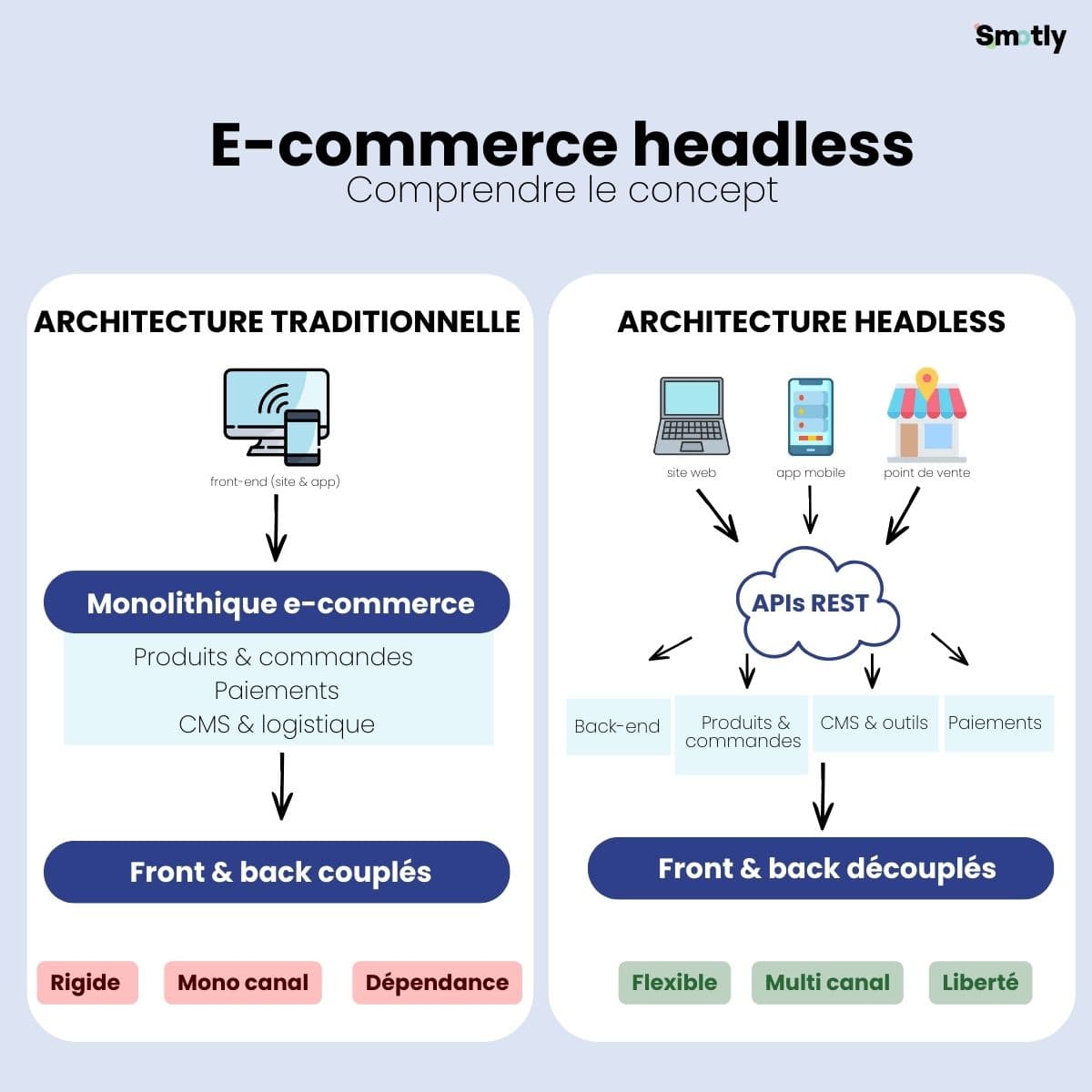
In a traditional e-commerce platform like Shopify or Prestashop, the front-end (what users see) and the back-end (management of products, orders, etc.) are coupled. Everything is integrated into the same system. This approach has advantages, simplicity of integration, ease of handling, but quickly becomes limiting:
- Difficulty personalizing the user experience
- Performance limited by platform constraints
- Stacking of modules, plugins or other apps as soon as a slightly specific need appears
- Impossible to reuse the back-end for other channels (mobile application, terminal, IoT)
- Total dependence on a supplier (vendor lock-in)
L’architecture headless
Headless commerce completely separates the front-end from the back-end. The back-end (Medusa in our case) exposes all its functionalities via REST APIs. The front end (your website, mobile app, etc.) consumes these APIs to display products and manage interactions.
🟢 The concrete advantages of this approach:
- Total freedom in design and UX: you can create any interface without technical constraints
- Optimal performance: you choose the fastest front-end technologies (Next.js, React, Vue.js, etc.)
- Omnichannel experience: a single backend can power your website, your mobile app, your in-store terminals, and even voice interfaces
- Scalability: You can scale the front-end and back-end independently
- No vendor lock-in: you own your code and can migrate more easily
With Medusa, you benefit from this flexibility while taking advantage of pre-built commerce modules (Cart, Payment, Order, Product, etc.) which prevent you from reinventing the wheel. It’s the best of both worlds: the power of custom with the speed of pre-built.
2. Medusa features: a platform adapted to different e-commerce models
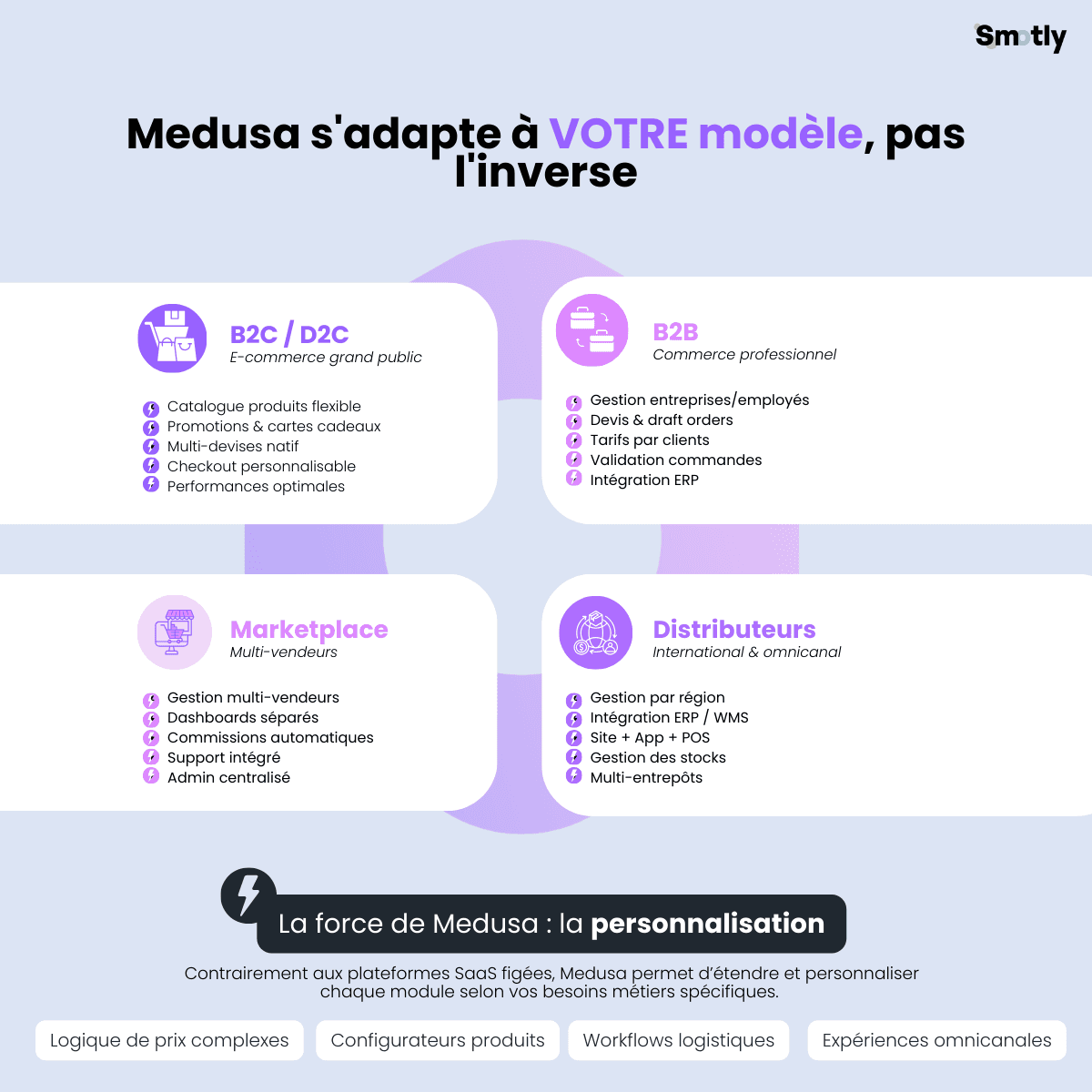
Medusa.js is not limited to a simple e-commerce backend. It is a modular headless framework, designed to adapt to different types of online commerce: B2C, B2B, marketplace or distribution networks.
Medusa's objective is simple: provide the essential building blocks of e-commerce (product catalog, orders, payments, customers, logistics) while giving developers the freedom to build a platform perfectly adapted to the needs of the business.
This approach makes it possible to create tailor-made e-commerce platforms without starting from scratch, while retaining the advantages of a modern and scalable architecture.
2.1 Medusa for B2C: creating efficient purchasing experiences
For brands that sell directly to consumers (D2C / B2C model), Medusa allows building fast, flexible and fully customizable online stores.
Product catalog management is particularly powerful. Companies can create products with multiple variations (size, color, configuration, etc.), organize their catalog into collections and categories, and enrich product sheets with attributes specific to their activity.
On the customer experience side, Medusa makes it possible to develop modern purchasing journeys: targeted promotions, real-time inventory management, integrations with major payment providers like Stripe or PayPal, or even multi-region deployment with different currencies and tax rules.
Thanks to its headless architecture, the front-end can be developed with modern frameworks like Next.js or React, which allows optimizing performance, SEO and user experience.
For D2C brands who want to differentiate themselves with a unique shopping experience, Medusa offers freedom that traditional SaaS platforms often limit.
2.2 Medusa for B2B: managing complex business workflows
B2B commerce presents very different needs from traditional e-commerce: specific pricing per customer, assisted orders, quote management or even integration with internal systems.
Medusa helps meet these needs thanks to its extensible architecture. Businesses cancreate customer groups with specific pricing rules, manage orders in draft form, or set up validation workflows before finalizing an order.
This flexibility is particularly useful for companies that sell to partners, distributors or professional customers with specific commercial conditions.
Integration with external systems is also a strong point. Medusa can easily be connected to an ERP, PIM or logistics management system to automate order flows, inventory management or invoicing.
For B2B companies wishing to digitize their business without being limited by the constraints of traditional platforms, Medusa represents a particularly solid technical base.
2.3 Medusa for marketplaces: manage multiple sellers
Many companies today want to launch multi-seller marketplaces, allowing different merchants to sell their products on the same platform.
Thanks to its modular architecture, Medusa can serve as a basis for building this type of platform. It becomes possible to manage multiple sellers with their own product catalogs, while maintaining centralized control over orders, payments and commissions. Platform administrators can thus monitor seller performance, manage order flows and automate certain revenue distribution rules.
Medusa APIs also make it possible to create different interfaces for sellers and customers: website, mobile application or internal management tools.
This technical flexibility makes it possible to build marketplaces adapted to many sectors: retail, specialized products, services or distribution.
2.4 Medusa for distributors: managing logistics and internationalization
Distribution companies often have specific constraints: management of large catalogs, multiple warehouses, complex logistics rules or international expansion.
Medusa offers several useful features in this context:
- The regions system allows you to configure different markets with their own settings: currency, taxes, payment providers and delivery options. For example, a company can simultaneously manage a European, American and Asian market from a single platform.
- Inventory management can also be synchronized with external logistics systems to maintain accurate inventory visibility.
- Thanks to its API-first architecture, Medusa can easily integrate with existing business tools such as an ERP or a warehouse management system.
For retailers looking to modernize their e-commerce infrastructure, Medusa offers a flexible foundation capable of supporting international growth.
2.5 A platform designed for personalization
Whatever the e-commerce model, the real strength of Medusa lies in its personalization capacity. Unlike many SaaS platforms, features are not fixed. Modules can be extended, replaced or enriched to meet specific business needs.
This allows, for example, to create:
- 💵 complex pricing logic
- 🛍️ advanced product configurators
- 🔁 specific logistics workflows
- 🤝 or even tailor-made omnichannel experiences
Medusa thus becomes a real technological base for building tailor-made e-commerce, capable of evolving with the needs of the company.
3. Which e-commerce platform to choose? Comparison of Medusa, Shopify, Sylius, PrestaShop and Magento
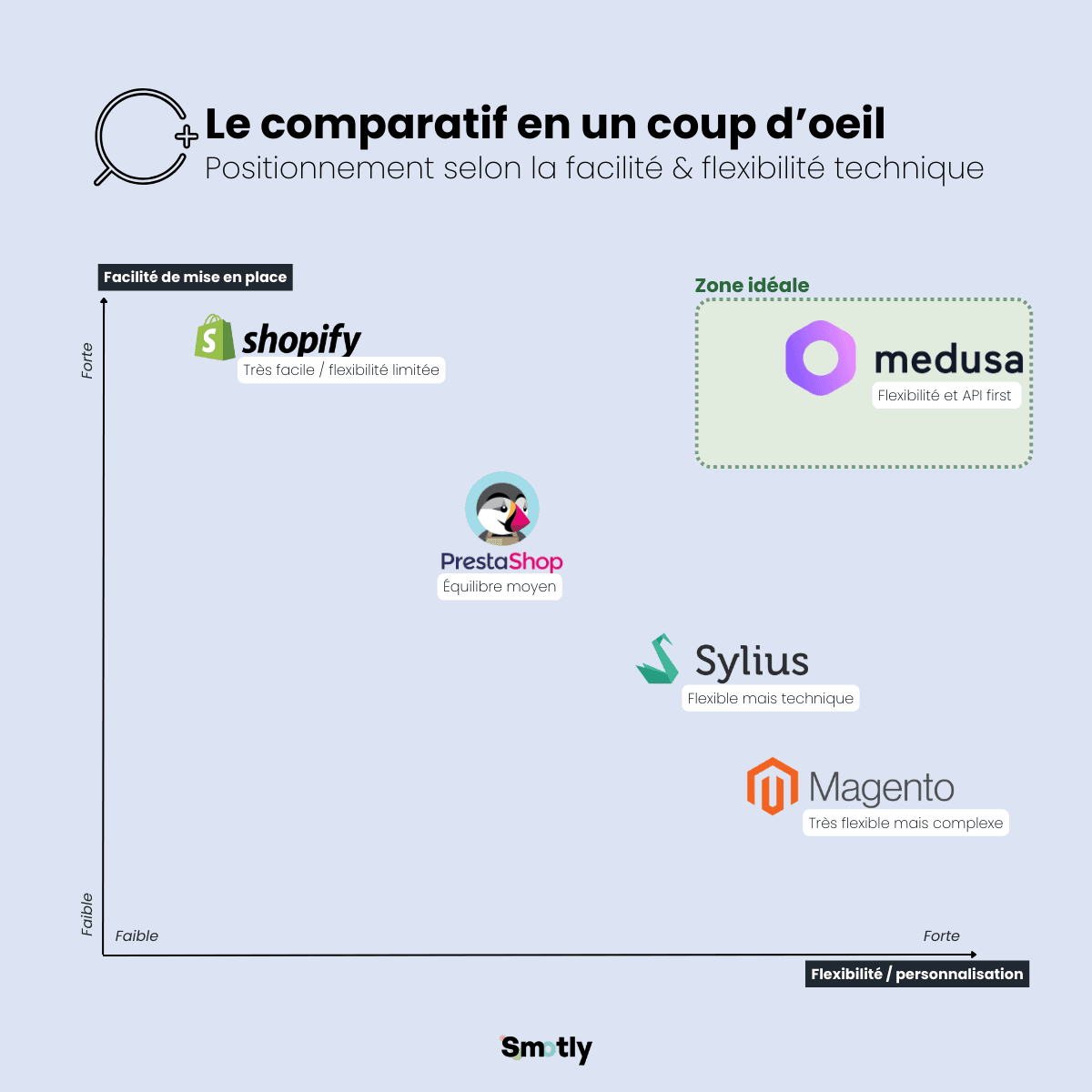
To choose the right e-commerce platform, it is essential to compare the most used solutions on the market: Medusa, Shopify, Sylius, PrestaShop and Magento. Here is a comparison table of the main features, costs and flexibility levels.
| Criterion | Medusa | Shopify Plus | Sylius | Prestashop | Magento |
|---|---|---|---|---|---|
| Platform type | Open source | Proprietary SaaS | Open source (Symfony) | Open source | Open source / enterprise |
| Architecture | Headless / API-first | Monolithique – headless possible | API-first, modulaire | Monolithique | Monolithique / Headless possible |
| Starting cost | Free (hosting + dev) | $2,300/month + development | Free (hosting + dev) | Free (hosting + modules) | Free (Community) / €22k+ (Commerce) |
| Additional fees | Infrastructure/development | Apps + frais transaction | Development | Modules payants | Infrastructure + development |
| Flexibility | ⭐⭐⭐⭐⭐ | ⭐⭐ | ⭐⭐⭐⭐ | ⭐⭐⭐ | ⭐⭐⭐ |
| Headless | Oui | Possible | Possible | Non | Possible |
| Performance | ⭐⭐⭐⭐⭐ | ⭐⭐⭐⭐ | ⭐⭐⭐⭐ | ⭐⭐ | ⭐⭐⭐ |
| SEO | Full control | Bon | Bon | Bon | Bon |
| Ease of use | Very simple | Very simple | Technique | Moyenne | Complexe |
| B2B | Personnalisable | Limited standard | Very good | Modules | Fort |
| Marketplace | Personnalisable | Apps | Extensions | Modules | Extensions |
| Omnicanal | ⭐⭐⭐⭐⭐ | ⭐⭐⭐ | ⭐⭐⭐⭐ | ⭐⭐ | ⭐⭐⭐ |
How to choose the right platform?
Each solution corresponds to a different type of project:
- : ideal for launching a store without great complexity with standard needs that are easy to handle.
- : suitable for SMEs with standard needs. Too rigid for complex needs which will require the stacking of modules that are difficult to maintain.
- : relevant for personalized e-commerce projects based on Symfony but requires technical profiles. Development and maintenance costs can quickly add up.
- : enterprise solution for large platforms. Technical complexity and implementation costs can be significant.
- : particularly interesting for modern, highly customizable headless architectures. The integrated AI is a real “game changer”.
4. Medusa, the new threat for e-commerce SaaS
Medusa.js is shaking up the e-commerce market. A trend is being confirmed: companies are abandoning proprietary platforms to regain control of their technology stack. And Medusa.js is at the heart of this revolution.
The numbers speak for themselves: 32,000+ GitHub stars, 400% community growth in 18 months and brands like Heineken, Mitsubishi or Tekla migrating to Medusa.
Why this explosion?Because businesses are tired of paying increasing monthly fees for platforms that limit them. Because they want truly differentiating experiences, not generic themes. Because they need to be able to adapt their back office to their business processes and automate them. Because they have understood that headless commerce is no longer an option but the standard architecture of modern e-commerce.
Medusa embodies this future: open source, flexible, efficient, and above all, truly belonging to you. Companies that adopt Medusa today are not taking a risky bet, they are taking a step ahead of their competitors still locked into obsolete solutions.