

Do you aim to connect your ERP directly with your e-commerce site in order to save time? Do you want to manage your business easily and efficiently? This article is made for you!
We have gathered all the information and advice necessary to connect your ERP with your e-commerce site.
E-commerce: a growing sector
According to official figures from the e-commerce and distance selling federation (fevad), the e-commerce sector saw an increase of 15.1% with a turnover of more than 129 million in 2021. In comparison during the year 2020, online sales had only increased by 8.5%.
Indeed, as we have seen through our article on the omnichannel approach, consumer habits have changed. This change in habits is notably due to the CoVid-19 pandemic which affected the entire world in 2020. The context has in fact accelerated the process and pushed consumers to change their vision and way of consuming.
In order to cope with the rise of this new mode of consumption, the e-commerce sector has had to adapt. Among these innovations, we find in particular: the development of payment platforms and accepted payment methods (bank card, transfer, PayPal, several times without fees, etc.), the increase in expenses made via a mobile phone, the “Click&Collect” option or even the reduction in delivery times.
The e-commerce sector therefore never stops evolving and requires optimization of processes but also the guarantee of management which is intended to be increasingly complex in order to maintain customer satisfaction.
We will show you how connecting your ERP to your online sales site allows you to manage these different complex aspects required by managing an e-commerce site.
What is an ERP?
As we were able to talk about in our article on the ERP offer from the publisher Microsoft, Business Central, an ERP or ERP (Integrated Management Software) is software that provides a set of integrated functions.
These functions allow you to manage your business: from entering quotes, orders, invoicing, inventory management to accounting entries.
In other words, integrated management software is software specifically designed to effectively manage all of a company's internal management processes.
Connecting an ERP to your e-commerce site: the advantages
Choosing to connect your business management system directly with your e-commerce site can have many advantages. Among these advantages, we can find:
Avoid mistakes by saving time
Connecting an ERP to your e-commerce site allows you to avoid re-entering orders placed on your site in your management software. This makes it possible to automatically generate order preparation and the corresponding delivery documents. In addition, online payment is directly transferred to accounting, no need to re-enter it.
Integrating your different management and sales systems will therefore allow you to save significant time. This will help you avoid entry errors as much as possible because orders will be directly transmitted thanks to the automation of data collection, storage and updates.
Increase customer satisfaction
Linking your ERP to your e-commerce site also allows you to more easily track the progress of the order. Your management software will send the corresponding information directly to your customers. They will know in real time the status of their orders without having to contact you. Which by definition will give satisfaction to your customers.
Simplified inventory and pricing management
It is now common to find stock quantities per product on e-commerce sites. Especially when the Click&Collect in-store delivery option is available. Creating a connector between your two entities will allow you to keep your stocks up to date.
In addition to real-time stock management, the connector also allows the management of prices and promotions by product. This management will be ensured via the connector which will instantly feed the product sheets.
In addition, your customer file can also be linked to your ERP in order to be able to make changes to customer data, such as when changing address, telephone number or even payment information.
Acceleration of the supply chain
The supply chain can also be automated. To do this, simply integrate an e-commerce ERP which will retrieve the data from new orders in order to transmit them to the logistician. As a result, order preparation time is reduced without losing quality. This acceleration of the supply chain offers better compliance with delivery times and thus optimal customer service.
In addition, the ERP processes invoices that correspond to orders by generating them automatically. This allows real-time transmission of information for faster processing. All of this allows online sales sites to operate more efficiently while freeing up human resources to focus on more strategic tasks for the business.
The important steps to connect your ERP to your e-commerce site
The methods of integrating a management system into your e-commerce are diverse and varied. Indeed, depending on the hosting platform on which your online site is hosted, the terms and conditions differ.
However, there are a few so-called basic steps. They are essential so that all conditions are met for successful integration.
Fluid flow exchanges between the two entities
In order to ensure smooth flow exchanges between your ERP and your e-commerce site, you must first ensure that your two entities are capable of exchanging data in real time. Mainly, for everything relating to commercial management data (orders, prices, payments, stocks, delivery information and customer files, etc.).
Choosing so-called reciprocal integration
To obtain fluid exchanges between the two entities, it seems essential to opt for reciprocal integration. This method consists of integrating your management software into the CMS of your online site. To do this, the data must be integrated into the ERP. Thus, the information will be updated automatically within the two entities using the connector.
Opt for a web application
To ensure that the integration of your management software and interconnected data exchanges are more fluid and faster, it is recommended to use a web application or SaaS mode. Indeed, these solutions are hosted on the Cloud and can be easily integrated through the use of APIs. Choosing to use an API makes it possible to avoid importing and exporting different data which can be sources of errors.
Training your employees
Beyond being a technical challenge, the integration of your management software into your e-commerce site represents new working methods. Your employees will therefore have to adapt to this change. It therefore seems necessary to support them in this new stage of your business.
This support includes training for the users concerned. They go through specialized workshops to learn how to use the tool, discover its specificities, etc. You can also consider setting up support to help them if necessary.
La phase de test
As with every software change, a testing phase must be planned. This phase will allow you to highlight the quality of the software or highlight potential errors.
This will allow you to make the corrections or adjustments necessary for the proper functioning of your software before its official use within your company.
Smotlink : Business Central x BigCommerce
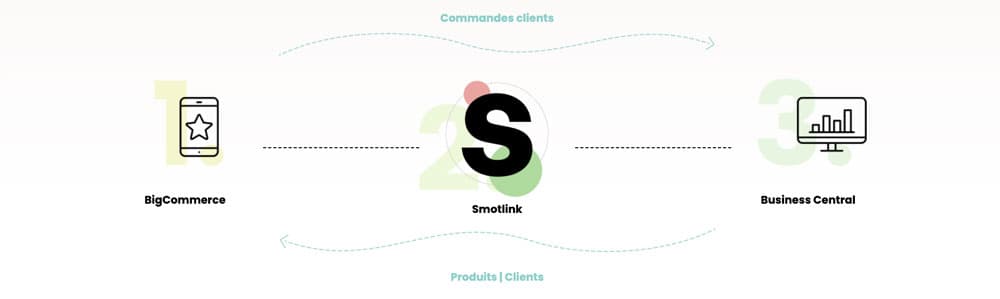
Smotly has developed a connector between Microsoft Business Central and BigCommerce. Indeed, the two SaaS mode systems have completely open APIs. Thus, the exchange of flows between Microsoft Dynamics Business Central and BigCommerce is extremely fluid and fast. This will make it possible to avoid errors, save time and improve customer satisfaction. But above all to offer an improved user experience and better management of your commercial data.
Smotly supports you
Integrating an ERP as well as connecting it to your e-commerce site requires a lot of technique and, above all, skills. Indeed, many flows are involved in the process: orders, product catalog, customer file, payments, etc. It is therefore strongly recommended to use a professional to carry out the various corresponding tasks.
Indeed, calling on a digital agency that masters your information system and is also an expert in e-commerce will allow you to save time and provide consistency to your two systems.
Smotly supports you throughout this process. From the pre-sales audit, to the integration of your ERP while connecting it to your e-commerce site, our team of experts will be there to advise you and offer you the best on the market.
Don’t hesitate to request a meeting to talk about your project!